Choosing a Compact Gear Motor is not simply a matter of finding the smallest unit that fits. The motor must deliver suitable speed and torque while matching the available space, power supply, and operating conditions. A gearbox can increase output torque, but it may also affect efficiency, noise, and overall dimensions. Those trade-offs matter in real equipment, where a few millimeters can complicate mounting or restrict access for maintenance.
Small details matter. Before comparing models, define the load, required output speed, duty cycle, and expected operating environment. Check the motor’s rated performance against the actual application, not just a peak figure on a product sheet. Consider shaft orientation, mounting style, wiring, heat buildup, and whether the motor will start under load. These checks help narrow the options and reduce the chance of choosing a unit that appears suitable but struggles in service.
The seven tips in this guide provide a practical framework for evaluating these factors. They cover sizing, gear ratio, motor type, efficiency, installation, operating conditions, and supplier information. A datasheet is useful, but it cannot answer every application-specific question; confirm uncertain ratings with the manufacturer when needed. There is no universally best choice. A selection that works well in a quiet, intermittent device may perform poorly in a hot space with frequent starts. That distinction is easy to overlook. The goal is a reliable fit for the real job, with enough evidence to explain why it was selected.
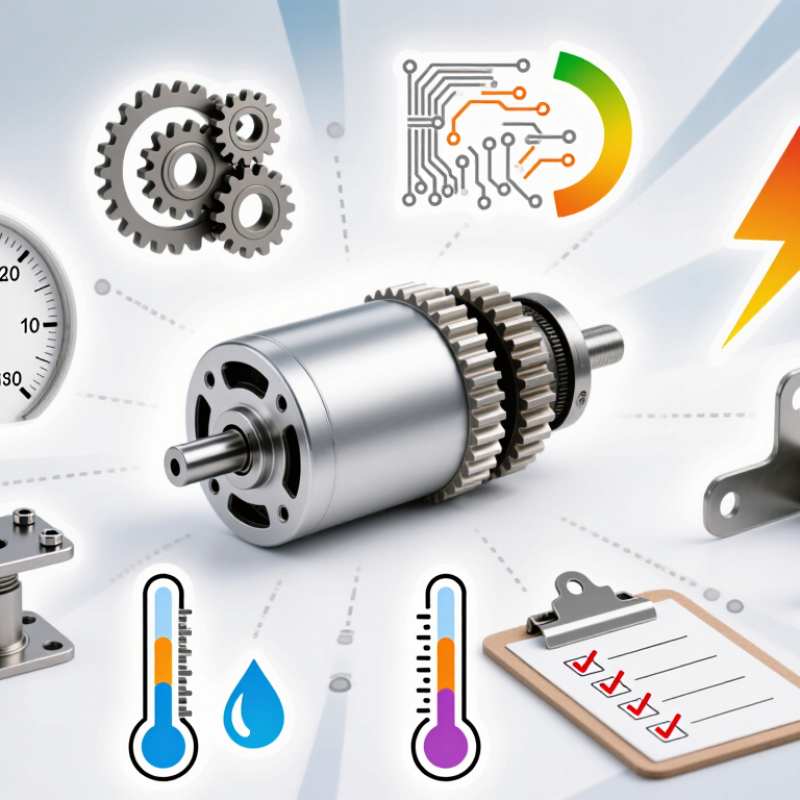
Before comparing compact gear motors, describe the job in measurable terms. What must the output shaft move, how heavy is the load, and how quickly must it accelerate? Record continuous and peak torque separately. A conveyor moving a steady tray needs different sizing from a small indexing table that starts and stops every few seconds. Include operating hours, cycles per hour, and any required holding torque. Small details matter.
The U.S. Department of Energy’s 2014 report, Improving Motor and Drive System Performance: A Sourcebook for Industry, estimates that motor-driven systems account for about 68% of electricity use in U.S. manufacturing. It also identifies system-level savings opportunities of 20–50% or more. That makes duty cycle and control strategy worth documenting, not guessing. Note the available voltage, speed-control method, mounting position, and the space around the motor. Dust, washdown, heat, or vibration can change the enclosure and thermal requirements. Check the actual ambient temperature, too.
Separate normal operation from the worst credible case. A motor that handles average load may overheat during repeated starts or a jam. This is easy to overlook. I would also state acceptable backlash and noise, even if the first estimate feels rough. It can be refined later. Keep assumptions visible, especially when load measurements are missing; an optimistic guess can produce a motor that fits the drawing but not the machine.
Record load weight, output speed, acceleration, operating hours, and starts per hour. Note voltage, mounting position, and available space. Small details matter.
Use torque in newton-metres = 9,550 × power in kilowatts ÷ speed in rpm. For example, 60 watts at 300 rpm requires about 1.91 Nm before allowances. Include friction and starting load.
No. Compare continuous torque with the normal load, then check peak torque for starts or brief jams. A short peak rating is not a continuous rating.
Record run time, rest time, starts, and reversals during a typical production cycle. Continuous S1 and intermittent S3 describe different operating patterns. Measure one cycle.
Brushed DC motors can be simple to control, while brushless motors can reduce brush wear. Steppers can support repeatable positioning, but may miss steps under excessive load. Check controller needs.
Spur gearboxes are often compact, but may be noisier. Planetary designs can deliver high torque in limited space. Worm gearboxes turn motion at a right angle, but can lose more energy as heat.
Dust, washdown, vibration, and warm enclosures can affect protection and cooling. Check ambient temperature and mounting conditions. The drawing may not show the real heat problem.
Review the torque-speed curve, gearbox efficiency, allowable radial load, and permitted starts per hour. Test the assembled unit for heat, noise, and positioning accuracy. My first load estimate is often wrong; I would recheck it.
Choosing the right Compact Gear Motor begins with a clear understanding of the application, including the load, available space, operating environment, and expected usage. Calculate the torque and speed the system requires, and consider the duty cycle so the motor can handle both normal operation and periods of increased demand. These requirements provide a practical basis for comparing motor types and gearbox configurations.
Next, evaluate the unit’s dimensions, efficiency, construction materials, and mounting options to ensure it fits the equipment and surrounding conditions. Check performance specifications against the application, and consider reliability, maintenance needs, and the level of technical support available from the supplier. A careful comparison of these factors helps identify a compact gear motor that balances performance, durability, and ease of integration.

 MeshLink Motor