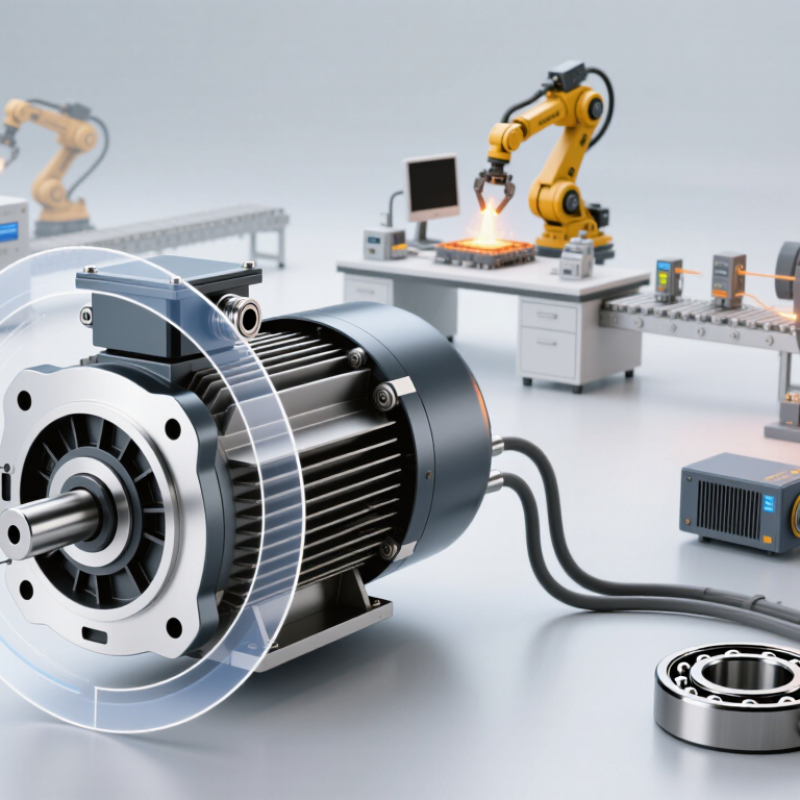
How to Choose the Right Direct Drive Motor?

Time:2026-10-11 Author:Sophia
0%

Choosing the right Direct Drive Motor is not simply a matter of selecting the highest torque rating. The correct choice begins with the machine’s real operating conditions, including speed, load profile, inertia, accuracy, and available installation space. A motor that performs well in a laboratory may struggle beside a hot furnace or under continuous peak load. Small details matter. Cable routing matters. Bearing life matters. Heat has nowhere to hide.

Professor Martin Doppelbauer, an electric-drive researcher at the Karlsruhe Institute of Technology, has stated, “The electric motor is the heart of every electric vehicle.” This principle also applies to industrial motion systems. The motor shapes efficiency, responsiveness, maintenance needs, and overall machine reliability. A Direct Drive Motor can remove gears, reduce backlash, and improve positioning accuracy. However, it may require larger physical dimensions, careful thermal design, and a more capable servo drive.

Experience shows that catalog comparisons rarely reveal the complete answer. Engineers should examine continuous torque, peak torque duration, allowable speed, rotor inertia, encoder resolution, and environmental protection. Ask practical questions. Will the motor run continuously? Can the structure absorb reaction torque? Is the feedback device protected from vibration?

No checklist is perfect. A spreadsheet can hide an installation problem. Therefore, this guide combines technical specifications with practical evaluation. It explains how to compare motor types, verify compatibility, estimate total cost, and avoid common sizing mistakes. The best motor is not always the strongest. It is the one that remains stable, efficient, and serviceable in the machine’s actual working environment.

How to Choose the Right Direct Drive Motor?

What Is a Direct Drive Motor and How Does It Work?

How to Choose the Right Direct Drive Motor?

What Is a Direct Drive Motor and How Does It Work?

A direct drive motor connects directly to the driven load. It removes gears, belts, and other transmission parts. The stator creates a rotating magnetic field, while the rotor follows that field. This movement produces torque at the shaft.

No gearbox is involved. That matters. Fewer mechanical parts can reduce backlash, noise, lubrication needs, and routine maintenance. The motor can also respond quickly during position changes. In workshop tests, this advantage is noticeable when a machine starts, stops, or reverses repeatedly. However, direct drive does not mean effortless operation. The motor still needs accurate feedback, suitable bearings, and careful thermal control.

Choosing the right model begins with the load. Measure continuous torque, peak torque, operating speed, acceleration, and duty cycle. Check the load inertia as well. A large inertia can make an apparently powerful motor feel slow or unstable. Installation space, shaft design, environmental temperature, and cable routing also matter. I have seen selections fail because engineers focused only on rated torque. That was a mistake.

A direct drive motor suits low-speed, high-precision applications particularly well. It may be less practical when the load needs very high speed at modest torque. In that case, a transmission system could offer better efficiency or cost. Review the real motion profile, not just the catalogue numbers. Small details often decide whether the motor runs smoothly or overheats.

Define the Motion Requirements for Your Application

How to Choose the Right Direct Drive Motor?

Define the Motion Requirements for Your Application

Choosing a direct drive motor starts with the motion, not the motor catalog. Record the load mass, moving radius, target speed, acceleration, travel angle, and positioning accuracy. Include the complete duty cycle. A rotary table that indexes every few seconds has different needs from a spindle running continuously.

Measure the real load if possible. Friction, imbalance, gravity, and external forces can change torque demand significantly. Calculate both peak torque for acceleration and continuous torque for operation. Also estimate the reflected inertia of the load. I have seen applications fail because engineers considered payload weight but ignored an oversized fixture. That mistake can create slow response, vibration, or overheating. This step is often rushed.

Consider the required settling time and feedback resolution. A high-resolution encoder may support precise positioning, but the control system must process its signals correctly. Check the motor’s speed-torque curve, thermal limits, bearing capacity, and installation environment. Dust, heat, shock, and limited space may affect reliability. More torque is not always better. An oversized motor can increase cost, inertia, and tuning difficulty. A first estimate may be wrong. That is acceptable. Build a practical calculation, test the motion with recorded data, and revise the requirements before final selection.

How to Choose the Right Direct Drive Motor? - Define the Motion Requirements for Your Application
Requirement Category Motion Parameter What to Define Typical Engineering Data Why It Matters for Motor Selection
Application Profile Motion type Rotary or linear motion, continuous indexing, reciprocating motion, or point-to-point positioning Rotary indexing table; 90° movement every 2 seconds The motion profile determines whether a rotary torque motor, linear motor, or another direct drive configuration is appropriate.
Speed Continuous and peak speed Maximum operating speed and the highest short-term speed during acceleration or deceleration Continuous: 300 rpm
Peak: 600 rpm
The motor must provide the required speed without exceeding its electrical, thermal, or mechanical limits.
Torque Continuous, peak, and holding torque Torque required to move the load, overcome friction, and maintain position against external forces Continuous: 8 N·m
Peak: 22 N·m
Holding: 12 N·m
Continuous torque is mainly limited by thermal performance, while peak torque is commonly limited by current and short-term overload capability.
Acceleration Required acceleration Target acceleration, deceleration time, and the required cycle time 0 to 300 rpm in 0.20 s Acceleration torque is calculated from inertia and angular acceleration: T = J × α, excluding friction and external load torque.
Load External load torque Process torque, friction torque, gravity torque, cutting force, belt tension, or other resistance Constant process torque: 4 N·m
Peak disturbance: 10 N·m
The motor should be sized for the combined acceleration torque, load torque, friction, and a suitable engineering margin.
Inertia Load inertia and inertia ratio Rotating inertia of the load, coupling, tooling, and any attached mechanism Load inertia: 0.018 kg·m²
Recommended reflected inertia ratio: preferably below 10:1
A lower load-to-motor inertia ratio generally improves dynamic response, tuning stability, and disturbance rejection.
Positioning Accuracy and repeatability Absolute accuracy, bidirectional repeatability, settling tolerance, and allowable position error Repeatability: ±0.01°
Settling tolerance: ±0.02°
Position requirements affect encoder resolution, feedback quality, mechanical stiffness, controller tuning, and thermal stability.
Feedback Position and velocity feedback Required encoder type, resolution, commutation feedback, and feedback-loop bandwidth Absolute encoder: 20-bit resolution
Required update rate: at least 1 kHz
Higher-resolution feedback can support finer positioning, but system accuracy also depends on mechanical error, installation, and control bandwidth.
Duty Cycle Operating cycle and RMS torque Motion duration, dwell time, cycle frequency, and torque profile over the complete duty cycle Cycle time: 5 s
Motion time: 2 s
Dwell time: 3 s
RMS torque: 7 N·m
RMS torque is used to evaluate continuous thermal loading; the motor should normally be selected with additional thermal margin.
Thermal Conditions Ambient temperature and cooling Ambient temperature, enclosure temperature, installation orientation, and available cooling method Ambient: 25 °C
Maximum ambient: 40 °C
Cooling: natural convection
Higher ambient temperature or restricted airflow reduces continuous torque capability and may require derating or forced cooling.
Mechanical Interface Mounting and load capacity Mounting diameter, shaft or hollow-bore size, allowable radial and axial loads, and coupling requirements Hollow bore: 40 mm
Radial load: 250 N
Axial load: 100 N
The motor bearing and housing must safely withstand the external loads without excessive deflection or reduced service life.
Environment Protection and operating conditions Dust, moisture, washdown exposure, vibration, shock, altitude, and hazardous-area requirements Ingress protection target: IP65
Operating temperature: 0 to 40 °C
Vibration: application dependent
Environmental conditions determine enclosure requirements, connector selection, sealing, corrosion protection, and allowable operating limits.
Electrical System Voltage, current, and drive compatibility Available DC bus or AC supply, peak current, continuous current, feedback interface, and control protocol DC bus: 320 V
Continuous current: 6 A
Peak current: 18 A
The motor, servo drive, feedback device, and control system must be electrically compatible across the complete operating range.
Performance Margin Selection reserve Allowance for load variation, friction changes, temperature rise, aging, and future process expansion Recommended initial margin: 15% to 25% above calculated continuous demand A practical margin helps avoid operation at the motor's maximum limits while preventing unnecessary oversizing and reduced system responsiveness.
Final Verification Application validation Confirm torque-speed performance, thermal behavior, positioning results, vibration, noise, and complete cycle operation Validate at minimum, nominal, and maximum load conditions Final selection should be confirmed using the actual motion profile and worst-case operating conditions rather than speed or torque alone.

Compare Torque, Speed, and Motor Size

How to Choose the Right Direct Drive Motor?

Compare Torque, Speed, and Motor Size

Direct drive motors connect directly to the load, so gearbox losses and backlash can be reduced. The decision begins with torque, not marketing claims. Calculate continuous torque at the working radius, then check peak torque during acceleration. A motor rated for 100 Nm continuously may not safely deliver 180 Nm for repeated cycles. IEC 60034-1 emphasizes rated operating conditions, temperature rise, and duty type. These details matter on a conveyor, rotary table, or robotic joint.

Speed changes the selection quickly. A low-speed application usually needs higher torque, while high speed may demand better balancing and stronger cooling. The International Energy Agency reports that electric motor systems consume roughly 40% of global electricity, making efficiency a practical design concern. Direct drive can improve system efficiency, but only when the motor operates near its useful speed range. Oversizing is tempting. It can increase cost, inertia, and energy use.

Motor size also depends on torque density, cooling space, allowable heat, and shaft loads. Compare the motor’s continuous torque at the actual speed, not only its peak figure. Check the rotor diameter and installation envelope beside the coupling area. Measure twice. One overlooked bearing load can distort the entire choice. A professional selection should compare manufacturer test data, IEC duty ratings, and measured load profiles. Static torque tests alone are insufficient, and that is where many early designs become too optimistic.

Evaluate Precision, Efficiency, and Operating Conditions

How to Choose the Right Direct Drive Motor?

Evaluate Precision, Efficiency, and Operating Conditions

Choosing a direct drive motor starts with the motion profile, not the catalog rating. Define the required torque, speed, acceleration, and stopping accuracy. A motor may provide excellent peak torque yet struggle with continuous heat removal. In practical testing, encoder resolution, bearing stiffness, and mechanical alignment strongly affect positioning results. Small installation errors can become visible at the tool tip.

Efficiency depends on more than rated power. Check torque at the actual operating speed, because direct drive motors often perform differently across the speed range. Review winding temperature, cooling method, duty cycle, and regeneration during deceleration. A tightly controlled motor can still waste energy if it repeatedly accelerates an oversized load. I have seen designs pass calculations but miss real-world efficiency targets. The assumptions were too clean.

Tips: Record the load inertia before selecting the motor. Compare continuous torque with peak torque. Measure cabinet temperature during a full operating cycle. Check dust, moisture, vibration, and ambient temperature at the installation site. Keep feedback cables separated from power cables. Measure twice. Leave thermal margin.

Operating conditions also influence reliability. High humidity may require additional protection, while frequent starts can increase thermal stress. Review maintenance access and cable movement before final approval. A careful selection balances precision, efficiency, and the conditions the motor will actually face.

Select the Right Motor Type and Verify Compatibility

How to Choose the Right Direct Drive Motor?

Select the Right Motor Type and Verify Compatibility

Choosing a direct drive motor starts with the motion profile, not the catalog headline. Rotary torque motors suit low-speed, high-torque axes without gear backlash. Linear motors fit fast, precise travel stages. Hub motors may simplify compact wheel or conveyor designs. The International Energy Agency estimates that electric motor systems consume about half of global electricity. Efficiency matters, but only when matched with real operating conditions.

Measure continuous torque, peak torque, speed, acceleration, and duty cycle. Include friction and emergency-stop loads. A motor that survives a ten-second peak may overheat during repeated cycles. Check rotor inertia against the load inertia. Excessive mismatch can create vibration and poor servo tuning. In practice, engineers often underestimate cable bending space and thermal losses. That mistake is expensive.

Compatibility requires more than matching voltage. Confirm the amplifier’s continuous and peak current ratings, feedback protocol, encoder resolution, and commutation method. Verify shaft dimensions, mounting tolerances, protection rating, and cooling requirements. IEC 60034-30-1 defines motor efficiency classes, but its ratings do not replace application testing. The U.S. Department of Energy reports that motor-driven equipment uses roughly one-quarter of national electricity in the United States, reinforcing the value of correct sizing. A useful test is simple: run the complete assembly at the worst expected load, then record temperature, settling time, noise, and current. The first selection may be wrong. Measure before you commit.

FAQS

Why should torque guide direct drive motor selection?

Calculate continuous torque at the working radius. Then check peak torque during acceleration. Do not trust peak ratings alone.

Can a motor rated for 100 Nm handle 180 Nm repeatedly?

Not necessarily. Repeated peak torque can cause overheating or failure. Check the duty cycle and the motor’s thermal limits.

How does operating speed affect motor choice?

Low-speed systems usually need higher torque. High-speed systems may require better rotor balance, stronger cooling, and tighter installation control.

What torque value should engineers compare?

Compare continuous torque at the actual operating speed. A large peak figure may look impressive but hide weak continuous performance.

How does motor size affect the complete machine?

Motor size depends on torque density, cooling space, shaft loads, and installation clearance. Oversizing can increase cost, inertia, and energy use.

What measurements improve motor selection?

Record load inertia, acceleration, stopping accuracy, and the full motion profile. Measure cabinet temperature during a complete operating cycle.

Which installation details can reduce positioning accuracy?

Poor alignment, flexible bearings, and limited encoder resolution can create errors. A small mounting mistake may appear clearly at the tool tip.

How do environmental conditions affect reliability?

Dust, moisture, vibration, and high ambient temperature increase risk. Check cable movement and maintenance access before final approval.

Why can calculated efficiency differ from real efficiency?

Calculations may assume clean conditions and ideal loading. Real systems repeatedly accelerate, decelerate, and generate heat. The assumptions may be too optimistic.

What safety margin should remain during selection?

Leave thermal and mechanical margin. Static torque tests are insufficient. Measure twice. Recheck the bearing load.

Conclusion

Choosing the right Direct Drive Motor begins with understanding how it produces motion. Unlike systems that use gears, belts, or other transmission components, a direct drive design connects the motor directly to the driven load. This can reduce mechanical losses, simplify maintenance, and improve responsiveness. Before selecting a motor, define the application’s motion requirements, including load size, acceleration, positioning accuracy, duty cycle, and available space.

Next, compare the motor’s continuous and peak torque, operating speed, physical dimensions, and thermal capacity. Precision, energy efficiency, noise, vibration, environmental conditions, and installation requirements should also be evaluated carefully. Consider factors such as temperature, dust, moisture, and the need for continuous or intermittent operation. Finally, choose the motor type that best matches the required motion profile and confirm compatibility with the controller, feedback device, power supply, mounting structure, and safety systems. A complete evaluation helps ensure reliable performance, efficient operation, and long-term suitability for the application.

Sophia

Sophia

Sophia is a dedicated marketing professional with an exceptional depth of knowledge about her company's products and services. With a keen understanding of market trends and customer needs, she crafts insightful blog posts that not only inform but also engage readers, enriching the company’s online......